Question-led brief for array work

Pv insulation tester

A pv insulation tester brief fails when the voltage of the array and the voltage of the meter are still unspoken. LinkScope Sourcing 58 uses this planner to list the open choices before an alternate instrument is accepted. LinkScope Sourcing 58 coordinates quotes without acting as the array engineer. It does not certify an array and it does not treat a motor megohmmeter as a string tool by default.

Start with system DC voltage. Many module strings are discussed at 1000 V DC. Some newer arrays are discussed at 1500 V DC. Ask the factory which test positions the model actually has, such as 250 V, 500 V, 1000 V, and 1500 V, and which position it recommends only as a datasheet limit rather than as your procedure. Your electrical method still governs the maximum you will apply.

Then write polarity, whether the procedure expects a wet insulation check, how many strings a crew tests in one visit, and whether the meter must tolerate residual voltage on a combiner that was opened minutes earlier. Measurement accuracy at the PV test voltage, for example plus or minus 3 percent plus 2 digits at 1000 V, should be a requested statement, not a slogan on a carton.
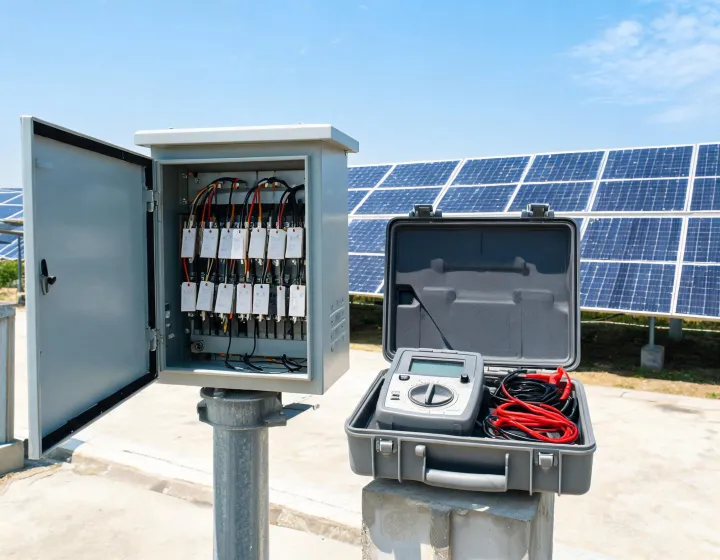
PV combiner area with a cased insulation tester and string tags

Planner lines and what still counts as open

These are completeness checks for the brief. They are not a project score and not an environmental claim. Eight lines are listed so a buyer can see which ones are still blank.

  1. Array voltage. 1000 V DC, 1500 V DC, or a lower control-circuit limit such as 250 V. Status: open until you circle one.
  2. Test positions. Confirm 500 V and 1000 V at minimum if the method uses them, plus 1500 V only when the procedure allows it.
  3. Source current. Ask whether the insulation source meets the 1 mA short-circuit discussion in IEC 61557-2, or a higher printed value such as 2 mA.
  4. Range. Example window to confirm: 0.01 megohm through 200 gigohm, or a higher upper limit if the sheet states the condition.
  5. Safety category. Request the IEC 61010-1 marking, such as CAT III 600 V, for the exact model, and the lead rating beside it.
  6. Timing. Spot, 60 second hold, or a 10 minute and 1 minute pair if you truly need polarization index on a string.
  7. Environment. Operating span, often written 0 C to 40 C, and ingress protection such as IP54 if the meter lives in a truck.
  8. Evidence. Datasheet revision, calibration traceability with serial link, and a clear exclusion list for case, fuses, and papers.

Scenario: 1500 V offer against a 1000 V method

Background: an EPC buyer preparing a pv insulation tester request for a 1000 V DC rooftop had received a quote whose headline voltage was 1500 V. Process: the planner marked 1000 V as mandatory, 1500 V as unused, and asked the factory to price the 1000 V configuration with leads and a 12 month calibration file called out. Result: the revised offer dropped the unused range from the commercial story, and the buyer could see that the lower configuration still needed its own measurement accuracy line.

Scenario: wet check left ambiguous

Background: a ground-mount crew sometimes sprays modules before a resistance check and sometimes does not. Process: the brief split dry and wet as two methods, asked which test voltage each method uses, and required the supplier to say whether the meter manual limits wet use. Result: one model was quoted for dry 1000 V work only, with wet use marked as outside the manual, so the crew did not treat the carton photo as permission.

Decisions to settle before you accept an alternate

New tester versus refurbished tester

New. Calibration date and lead condition are easier to describe when an owner asks which serial visited the array. Papers can be requested to ship with the unit.

Refurbished. May fit a discontinued procedure or a tight budget note when the seller states remaining support months, fuse condition, battery or cell type, and whether leads are original. Until those sentences exist, do not treat the refurbished price as the same scope.

Original instrument versus a compatible housing

Original. May align with a written method that names a maker and with that maker support route. You still need the datasheet of the exact revision, not the family name.

Compatible. May widen factories when test positions, short-circuit current, safety category, and connector fit are written and compared. A similar grip and a similar color do not establish that match. Connector mating cycle notes still belong on the lead plug the crew mates every morning.

String insulation versus other telecom measurements

In this brief. DC test voltage, resistance window, timing, category, calibration traceability, and accessories.

Out of this brief. VSWR, return loss, wavelength, optical budget, impedance of a DMM input, frequency range of an AC volt function, switching capacity, and MIMO. Those words describe other purchases. Mixing them into a pv insulation tester price hides the array scope.

High-end, mid-range, budget, or undecided remains a buyer preference, not a verified rating. Say it if it helps the search. It does not replace the eight lines above. Review inquiry names or move the completed lines to the contact form.

Send the PV planner as a factory request

Copy the closed lines and leave the open lines labeled unknown. Quantity, destination, and timing still belong in the same box. There is no upload. A target budget, if you have one, needs currency and a per-unit or whole-order basis, and it can be entered before any factory price exists.